


As the title suggests, we visited Audi’s plant in Ingolstadt today. The plant was huge, a few square kilometers, and around 2000 cars a day are produced there. Audi has many locations and over 80,000 employees, but this location only manufactures the Q2, A3, A4, A5, and their corresponding S or RS models. We saw massive presses to make the body panels that were fed sheet metal by robots. These presses were easily twice the size of an average house and there were huge overhead gantry cranes that moved the 30-50t dies that would be changed out whenever it was time to make a different panel. There were autonomous robots maneuvering through the plant with materials. The cars start as a frame where they move through a serpentine assembly line carried by a crane, and they are slowly assembled. The entire drivetrain and suspension are assembled on the subframe and after it is lifted into the car the car sits on a conveyor belt while workers finish the assembly. Once complete, the cars go through a few tests and inspections then are prepared for transport or pickup.
Audi also had an amazing museum displaying some of the coolest and most influential Audis. There were plenty of famous cars, and also cars I had never heard of.
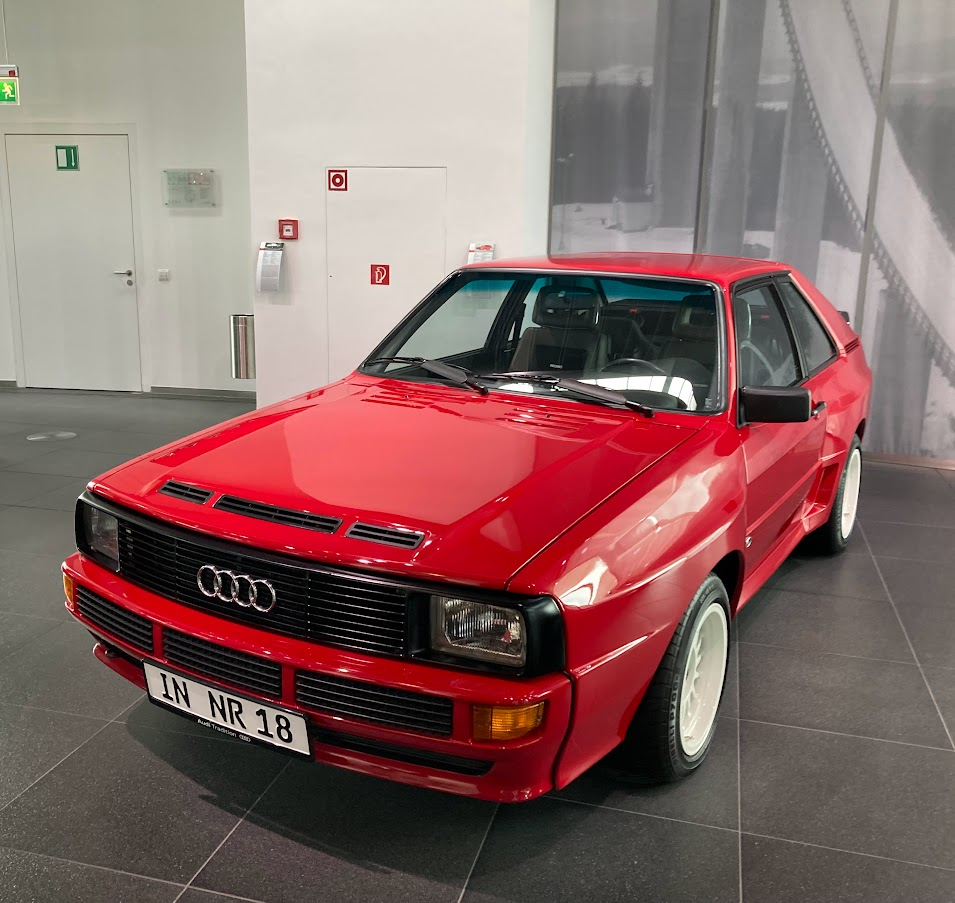
My favorite car in the museum was the Audi Quattro, a legendary car made famous by its presence in Group B rally.

We then went to a small show room where we could sit in multiple cars, my favorite of which was an R8. This was one of the last of the R8’s that will be made, and it had the V10 performance package.


Then we saw another final area, that was gated to the public with one of the most special cars there, an RS2 Avant. The RS2 was the first RS car Audi made, and it was the beginning of its partnership with Porsche. It is an understated car, but not to be underestimated during its time.

The Audi plant was a remarkable display of German engineering, and what is possible. The cars there were amazing although I fear some of the heritage and innovation will be lost when the ICE cars will no longer continue to be updated (2026). There’s more to an exciting car than rapid acceleration and I feel a lot of it will be lost if gas powered cars are banned. There will be no more time tinkering in the garage, no aftermarket parts or tuners, no DIY service, no manual transmissions, and most importantly no distinguishing roar of the many different engines. Electrification may be the future, but that doesn’t mean we have to forget the past. I hope we can innovate and find ways to still drive our favorite petrol sports cars and be sustainable.