


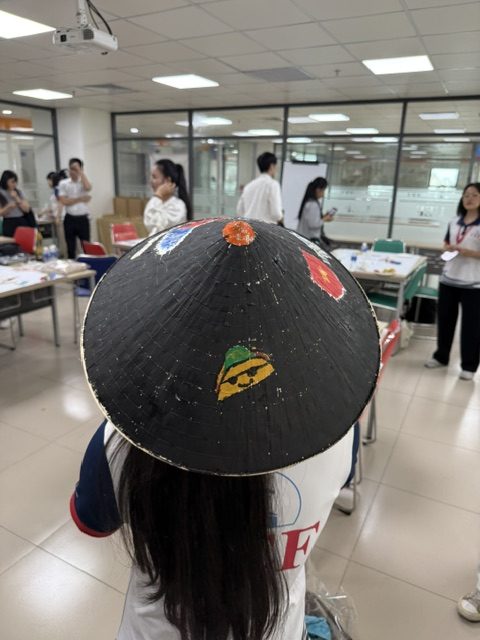
Today we started with another language session, but this time aimed at haggling down prices for our visit to the market later in the day. We painted traditional rice hats, but mine kept falling off my head because I forgot to tie the chin band on. We then departed to Ben Thanh market. It was hot, stuffy, chaotic, but fun. The haggling was a pretty unique experience that I haven’t had anywhere else, despite knowing I am getting scammed no matter how low I could get their prices. The shopkeepers were all persistent. Sometimes pretty mean too. I did not buy their products if they were mean. I would, however, rather hand my money to a vendor working 12 hours in a cramped stall than to some massive corporation. So it was not so bad. I also got to practice my phrases: Ba new? (how much?) Dat kwey! (too much!)..

We then ate lunch and headed to the US Consulate. I learned that Vietnam has a goal of becoming a high-income country by 2045. After being here for two weeks, my two cents is that it’s ambitious, but not impossible. Every single site visit we’ve done, despite having different operations and capital at their disposal: the infrastructure, population, work ethic, and mission for more global integration were present in all of the companies. Right now, Vietnam is trying to position itself as a potential alternative manufacturing hub to powerhouses like China for big US corporations. However, we learned how many of these corporations are first trying to be more sustainable, but solar panels, batteries, EV components are all sourced from China. Thus, it becomes impossibly hard for these companies, especially those in Vietnam, to make large progressions towards sustainability while most current policies are aimed at becoming less reliant on China through decoupling, but many of the required battery components that are used in renewable technologies must be sourced from China. Touche…. She also talked about how the current conflicts in the Middle-East were a bigger factor for Vietnam right now than the prior tariffs. This was surprising. With shipping routes disrupted and oil prices rising rapidly, they are the main benefactor and their ports here are busier than ever. On paper, perhaps it may be good to spur international traction. However, does Vietnam actually benefit from this? They’re absorbing more cargo, which has its own downsides, but the Iran war is also pushing the Fed to hike rates to fight stagflation, which makes their US-bound exports less expensive. I would personally not be very happy.

We ended the day with a chill waterbus tour. It was relaxing after a busy day.